
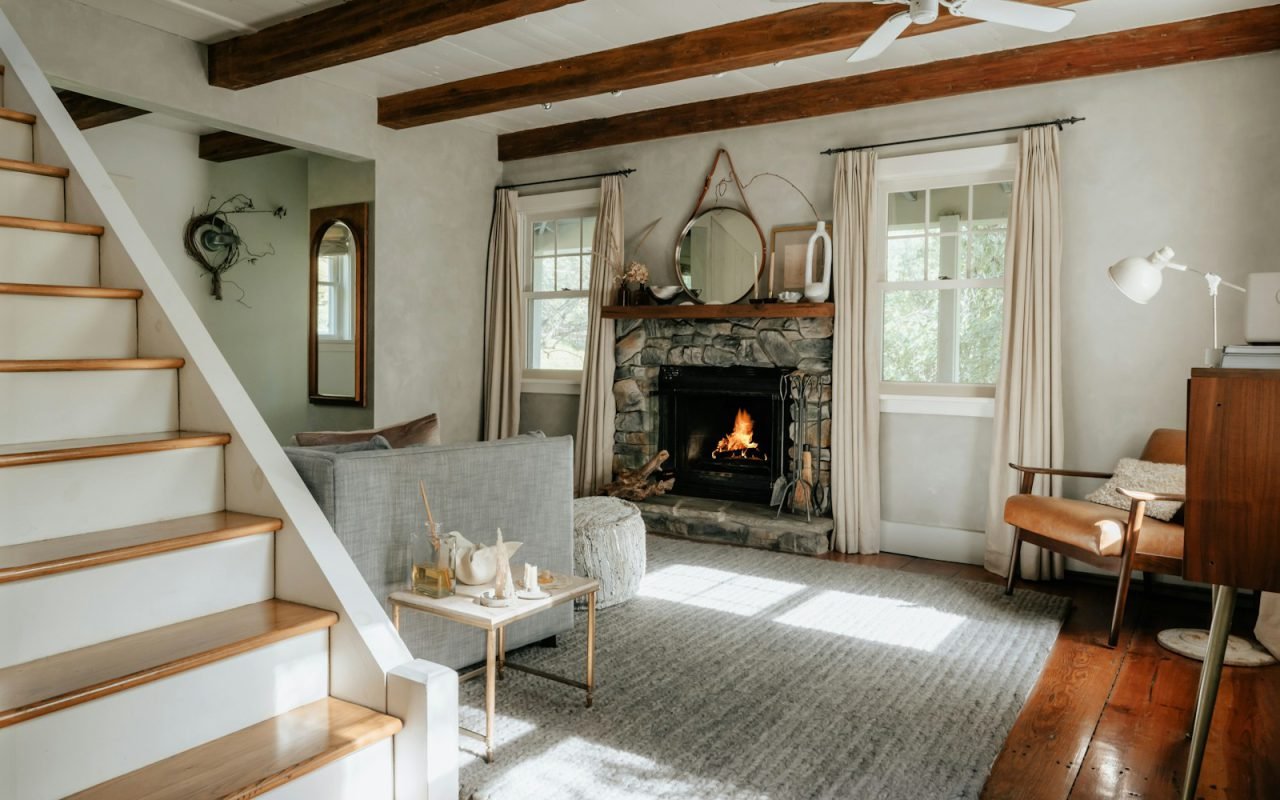
When Anna and Luke Mercer bought a 1920s farmhouse outside Woodstock, Vermont, the kitchen had no counters and the living room had six layers of wallpaper. Five years later, it is one of the calmest houses we have ever visited. The floors glow the color of maple syrup, the windows are a little crooked in the most charming way, and on the October afternoon we arrived, a fire was already crackling in the living room while a pot of soup simmered on the stove.
Nothing about the house feels rushed, and that is entirely by design. The Mercers, who moved from an apartment in Boston with two young children and a dog named Juniper, decided before they signed the papers that they would not try to finish everything at once. What followed was a restoration measured in seasons rather than weeks, and a family that learned to live gently with an unfinished house.
One room a year
The Mercers made a rule early: finish one room completely before starting the next. The living room came first, because it had the fireplace — and the fireplace meant winter was bearable. That first year, the rest of the house stayed as they found it. They cooked on a two-burner hot plate, kept clothes in plastic bins and washed dishes in a utility sink in the mudroom.


It sounds uncomfortable, and Anna admits there were evenings when it was. But having one finished, warm, beautiful room changed everything. “Whatever was happening in the rest of the house, we could close the door and sit by the fire,” she says. “It reminded us what we were working toward.”
The kitchen followed in year two, then the main bedroom, the children’s rooms and finally, last spring, the bathroom upstairs. Each project had a clear beginning and end. They did not start tearing out tile in the bathroom while the kitchen cabinets were still unpainted, and they never had more than one room under dust sheets at a time.
We could have finished in a year. We would have hated it. The slow way let us get to know the house.
Anna Mercer, homeowner
Why slow worked for them
Beyond keeping their sanity, the one-room rule had practical benefits. It spread the cost over several years, so they could pay for each project from savings rather than taking on a large loan. It also let them learn as they went. Luke taught himself to refinish floors in the living room; by the time he reached the bedrooms, he was fast and confident. Mistakes made early were small and contained, and they rarely made the same one twice.
Keep what the house gives you
They sanded the original pine floors instead of replacing them, and kept the crooked window frames. “The house tells you what it wants,” Anna says. “You just have to slow down enough to listen.”
Under worn linoleum and a layer of brown carpet, the pine boards were scratched, stained and in places patched with mismatched wood. A contractor suggested pulling them up and laying new flooring. Instead, Luke rented a drum sander, worked through the house over several weekends and finished the boards with a hard-wearing natural oil. The patches and nail holes are still visible, and the family loves them. “Every mark is a story we don’t know,” Luke says. “It feels wrong to erase them.”
The same thinking shaped the rest of the restoration. The original four-panel doors were stripped and rehung. An old built-in hutch in the dining room, painted mint green sometime in the 1950s, was carefully cleaned rather than refinished. Even the crooked window frames stayed, though the couple added interior storm panels to keep out the January wind.
When to replace
Keeping the old did not mean keeping everything. Before any decorative work began, the Mercers hired licensed professionals to update the electrical system, inspect the chimney and replace a failing furnace. “Charm is lovely, but safety comes first,” Anna says. Anyone restoring an older home should have wiring, heating and chimneys checked by qualified professionals before moving in, and older paint should be tested for lead before sanding.
Color from the land
Every paint color in the house was matched to something outside: birch bark white, moss green, the gray of the stone walls along the road. Anna collected small objects on walks through the property — a curl of bark, a flat stone, a sprig of fern — and took them to the paint store to match by eye.
The result is a palette that feels like it belongs. The living room walls are the soft white of birch bark, which keeps the space bright through short winter days. The kitchen cabinets are moss green, a color that looks almost gray on cloudy mornings and glows warm in afternoon sun. The children’s rooms are painted a pale sky blue matched, at their daughter’s insistence, to a robin’s egg found on the porch.

Anna painted large sample patches on several walls and lived with them for weeks before choosing. “Colors change completely between a gray March afternoon and a bright June morning,” she says. “If you can, live in a room for a whole season before you paint it.”
Living in the finished rooms
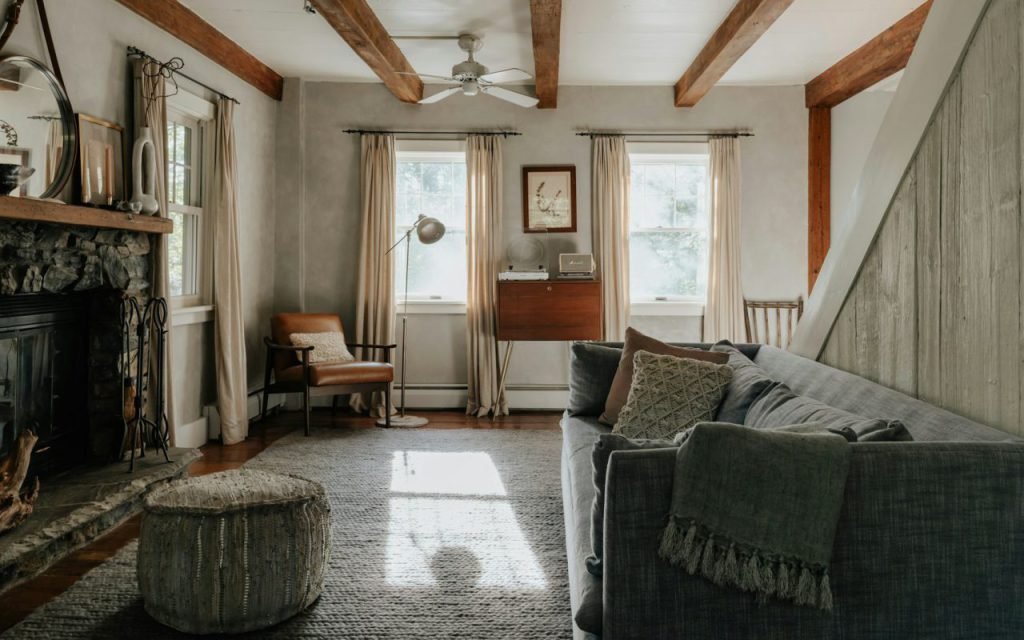
Walking through the house today, what strikes you is how little there is. The Mercers furnished slowly, too, buying one good piece at a time from estate sales, antique barns along Route 4 and a furniture maker in a nearby town. The living room holds a deep linen sofa, two old armchairs, a long pine bench and a basket of firewood. That is nearly all.
The kitchen, finished in year two, has butcher-block counters, open shelves and a deep farmhouse sink set under a window that looks out toward the barn. The children eat breakfast at a scrubbed table that came from a church sale for $40. The house is lived in, a little worn and entirely comfortable.
The family’s daily rhythm has slowed to match. Weekends are for walks, wood stacking and long meals rather than renovation marathons. Even now that the major work is finished, Luke keeps a small list of projects, and he works through them one at a time.
What they learned
We asked the Mercers what advice they would give anyone taking on an old house. Their answers were practical and, fittingly, unhurried.
- Sand before you replace — old floors are usually better than new ones
- Live in a room for a season before choosing paint
- Spend on the things you touch every day: handles, switches, taps
- Finish one room completely so you always have a calm place to retreat
- Hire licensed pros for wiring, heating and anything structural
Key takeaway: a restoration done slowly is easier on your budget, your family and the house itself.
As we left, the light was fading over the stone walls and the windows glowed amber against the dark hill. Anna stood on the porch with Juniper at her feet. “People ask when we’ll be done,” she said. “I’m not sure we ever will be. But that’s all right. The house isn’t in a hurry, and neither are we.”












Thanks for explaining this so clearly.
Great reporting — please keep following this story.