
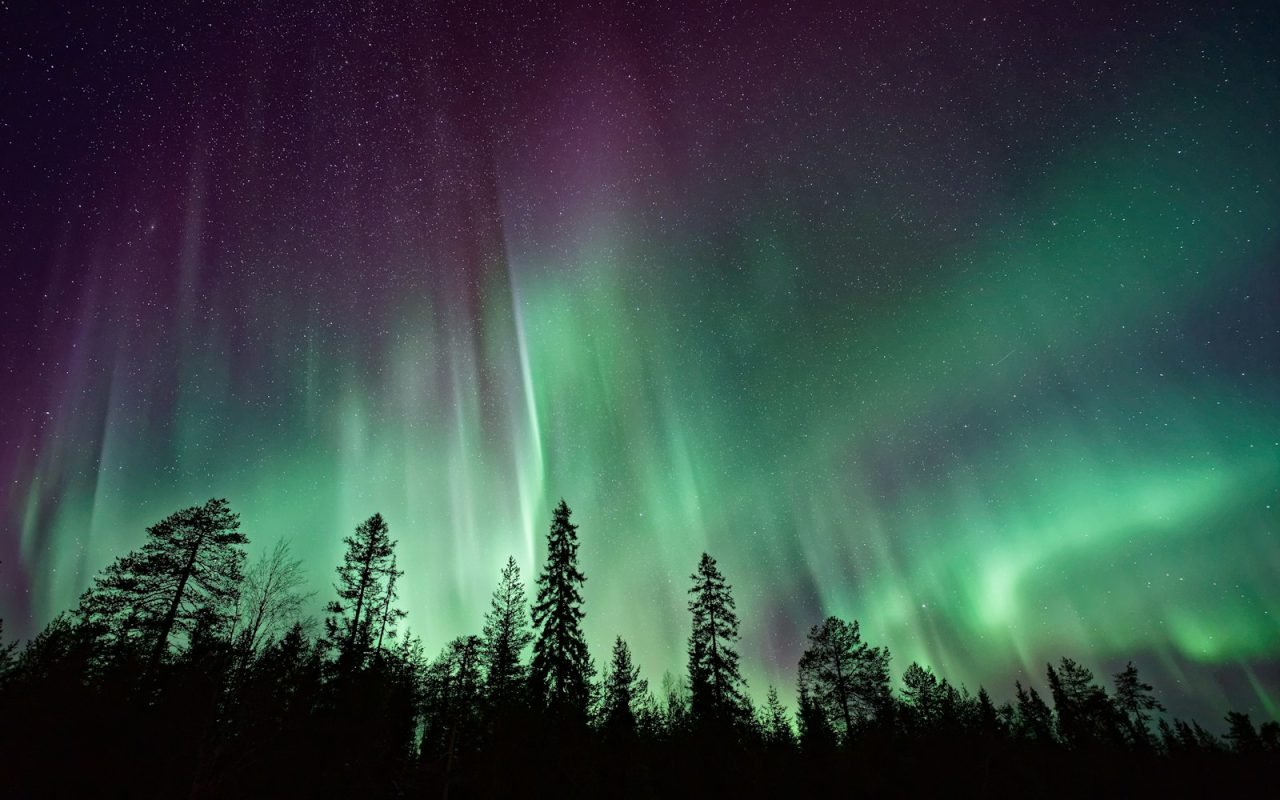
For most Americans, the northern lights have long been something you see in travel photos from Alaska, Iceland or northern Canada. Then, in the past couple of years, phones across the country started buzzing with aurora alerts, and people in places like Ohio, Texas and Georgia stepped outside to find the sky glowing pink and green. Auroras happen when charged particles from the Sun crash into gases high in our atmosphere and make them glow. The reason they have been reaching so far south has to do with the Sun’s own rhythm.
How an aurora works
The Sun constantly blows a stream of charged particles into space, called the solar wind. Most of the time, Earth’s magnetic field acts like a shield, steering those particles around the planet. But the field is not a perfect wall. Near the North and South Poles, its lines curve down toward the surface, and some energy and particles can be funneled into the upper atmosphere there.
When those fast-moving particles collide with oxygen and nitrogen atoms roughly 60 to 200 miles above the ground, they give the atoms extra energy. The atoms quickly release that energy as light, the same basic process that makes a neon sign glow. Millions of these collisions together create shimmering curtains, arcs and rays across the sky.


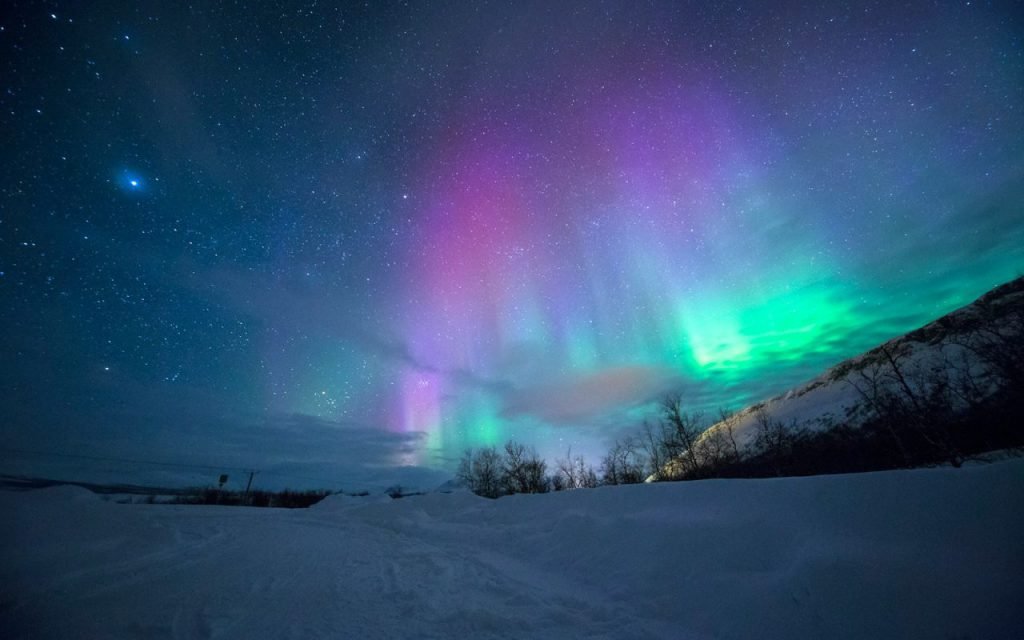
Normally, auroras appear in ring-shaped zones around the poles, called auroral ovals. In North America, the oval usually sits over Alaska and northern Canada. When the Sun sends a stronger burst of energy our way, that oval expands toward the equator, bringing the lights into view far farther south than usual.
The solar cycle
The Sun’s activity rises and falls about every 11 years. Near its peak, big solar storms are more common. Astronomers track this cycle by counting sunspots, dark patches on the Sun’s surface where intense magnetic fields gather. At solar minimum, the Sun can go weeks with few or no sunspots. At solar maximum, it can be covered with them.
Sunspot regions are the birthplaces of the most powerful solar eruptions. Solar flares release bursts of radiation, and coronal mass ejections, often shortened to CMEs, hurl huge clouds of magnetized gas into space. When a fast CME is aimed toward Earth, it can arrive in one to three days and slam into our magnetic field. The result is a geomagnetic storm, and the bigger the storm, the farther south the auroras can reach.
The current solar cycle has been more active than many scientists expected, which is a big part of why aurora sightings have become so common in the lower 48 states. Activity is expected to wind down gradually over the next several years, but strong storms can still happen on the way down. In fact, some of the most intense storms in past cycles came after the peak.
If an aurora alert pings after dark, go outside and look north. Then take a long-exposure photo.
Dr. Lena Ortiz, astronomer
May 2024
A powerful geomagnetic storm in May 2024 painted the sky as far south as Florida and northern Mexico. It was one of the strongest storms in decades, set off by a cluster of very active sunspots that launched several CMEs toward Earth in quick succession. When they arrived, the auroral oval swelled dramatically.
That night, social media filled with photos from places where most people had never seen an aurora: city parks, suburban backyards, beaches and farm fields across the South and Midwest. Many observers noticed that the colors looked faint or grayish to their eyes but blazed in vivid pinks and greens on their phone screens. A second strong storm in October 2024 brought another round of widespread sightings.
Storms that powerful can also affect technology. Space weather forecasters issue warnings so that power grid operators, satellite companies and airlines can prepare. Strong storms can disturb GPS accuracy, radio communication and, in rare cases, electrical systems. Most of the time, though, the biggest impact for people on the ground is a spectacular show.
Reading the forecast
Government space weather centers publish free aurora forecasts, and many apps translate them into simple alerts. Forecasts often use a scale called the Kp index, which runs from 0 to 9. A higher number means stronger geomagnetic activity and a better chance of seeing auroras farther south. In much of the northern United States, a Kp of 6 or 7 can bring a good display. For the Deep South, it usually takes a severe storm near the top of the scale. Forecasts are best treated as a heads-up rather than a promise, because conditions can change quickly.

How to see and photograph one
When an alert comes in, a little preparation goes a long way. Here is a simple plan:
- Get away from lights. Drive to a park, field or lakeshore away from streetlights and city glow, if you can do so safely.
- Look north. In the continental United States, auroras usually appear low on the northern horizon first.
- Give your eyes time. It takes 20 to 30 minutes for your eyes to adjust fully to the dark. Avoid bright screens while you wait.
- Use your phone’s night mode. Hold the phone very still, or prop it on something, and take a few-second exposure. You may see color your eyes cannot.
- Try a real camera. On a tripod, use a wide lens, the widest aperture, ISO 1600 to 3200 and an exposure of 5 to 15 seconds.
- Be patient. Auroras pulse and fade. A quiet sky can light up suddenly within minutes.
Dress warmly, even in spring or fall, and let someone know where you are going if you head to a remote spot at night.
Plan a trip north
If you would rather not wait for a rare storm, consider going to the auroras instead. In Fairbanks, Alaska, and the surrounding interior, the auroral oval passes overhead on many nights from late August through mid-April, when skies are dark enough. Northern Minnesota, Michigan’s Upper Peninsula and the dark-sky parks of Maine also see the lights several times a year during active periods. Plan for at least three or four nights, since clouds are the biggest enemy, and choose dates near a new moon so moonlight does not wash out fainter displays.
Quick facts
- Green usually comes from oxygen
- Red and purple appear higher up and from nitrogen
- Phone cameras often see colors your eyes miss
Those colors tell a story about altitude. The most common green glow comes from oxygen around 60 to 150 miles up. Rarer deep red light comes from oxygen even higher, where the air is extremely thin. Blue and purple tones come from nitrogen, often along the lower edges of active curtains. During storms that reach far south, observers often see mostly red, because they are looking at the very top of a distant aurora that rises above their horizon.
The reason cameras outshine our eyes is that human night vision relies on cells that are very sensitive to light but poor at detecting color. In dim conditions, the world fades toward gray. A camera sensor, collecting light for several seconds, does not have that limitation.
Keep looking up
Seeing auroras far from the poles is a rare treat, and the current stretch of high solar activity has given millions of people their first look. Even as the Sun gradually calms, more storms are likely in the coming years. Keep an aurora app on your phone, know where your nearest dark spot is, and be ready to step outside on short notice.
Key takeaway: the northern lights have been reaching unusually far south because the Sun is near the busy peak of its 11-year cycle, when powerful solar storms are more frequent.









Sharing this with my friends.
Saved this one for later. Really useful.